cancer-diaries
I was able to attend a full service in the morning, which is two sitting medation periods with walking meditation between followed by chants and prostrations.
Last night I noticed a tiny unassuming mouse come into and out of the room quickly. It entered and exited through a hole that appears to have been purpose built for mouses of that size to freely move in and out of. It’s not big enough for a rodent of a more concerning size to come and go, and field mice appear often in any farm where there is a dry place. This sort of relationship to animals is what I’ve come to expect here, but I haven’t had a conversation with anyone about it because if it wasn’t purpose built I think I’d like the mouse to have it for at least as long as this rain persists and avoid drawing any attention that might “fix” it if I’m wrong.
Concerning Lab Work
Received some labs that are looking things more specific to cancer. This isn’t a diagnosis, but the results are consistent with late stage cancer.

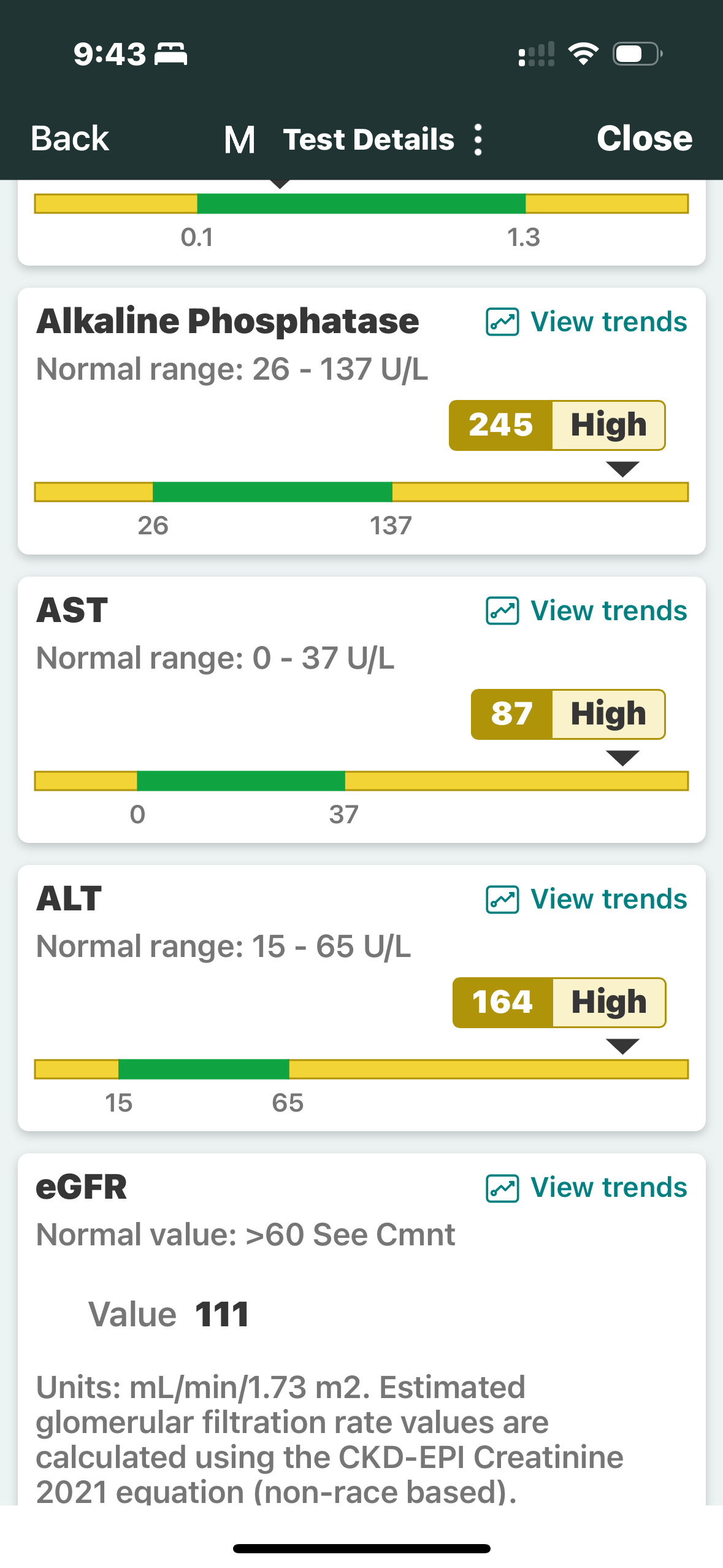
I don’t have historical labs to compare this to for obvious reasons, but I do have some relatively recent labs that looked at my liver enzyme levels. They go from “nothing wrong” to “slightly elevated” in 2 months and from that to “something is most definitely wrong” 1 months later, suggesting this is moving pretty fast.
It probably won’t get me in the queue for a biopsy any faster, will have to wait till Monday to call the oncologist, so I’m still likely to wait on that until after Thanksgiving.
Liver Enzymes 9/5/2024
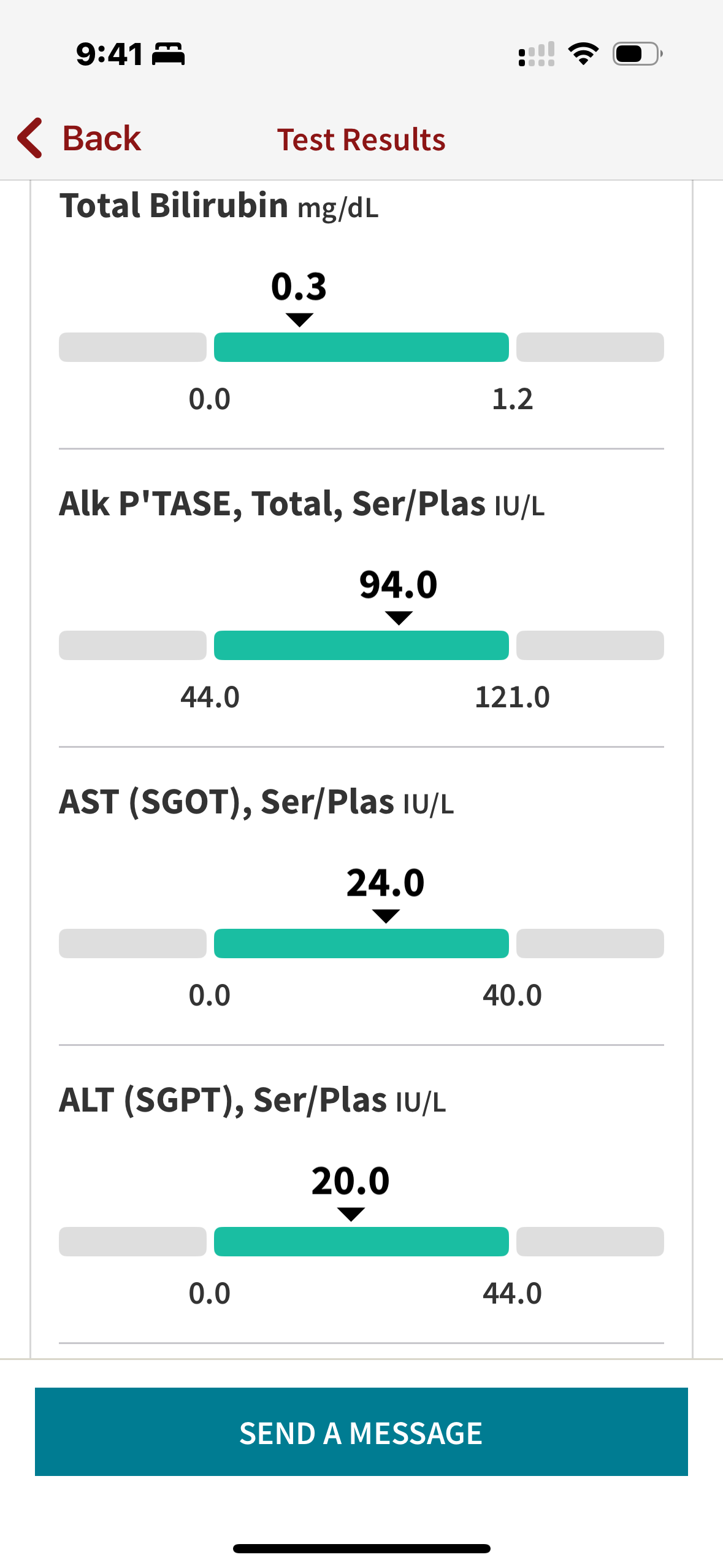
Liver Enzymes 10/27/2024
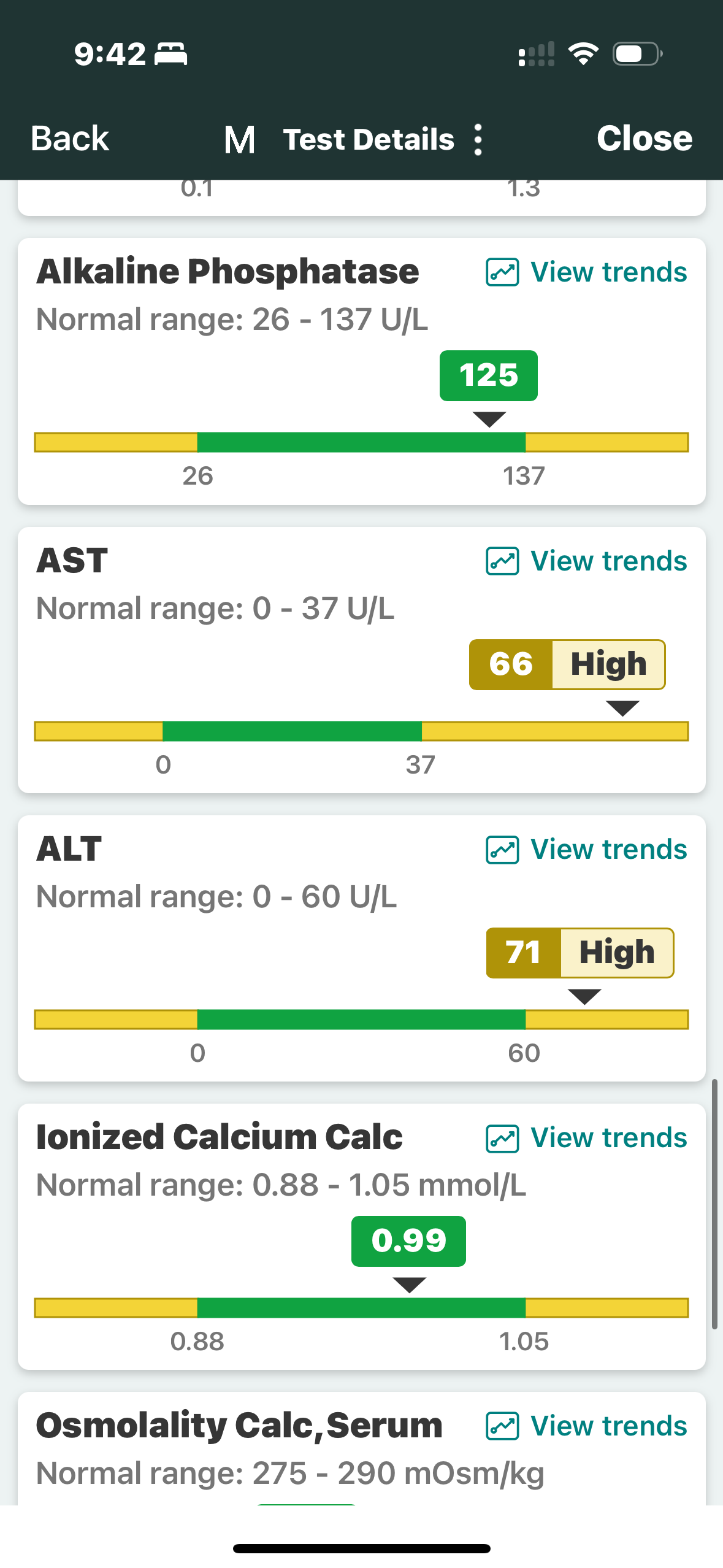
Liver Enzymes 11/19/2024
REI/CapitalOne Credit Card Drama
So, I buy a bunch of stuff at REI because I’m going on the road. I figure, it may not be the worst idea to have an REI credit card for the next time I’m in while I’m on the road. I listen to the whole pitch, the lady seems nice, so I get one. I’ve been an REI member since I lived in Seattle in the early 2000’s so it seems like a safe bet.
I’m expecting her to hand me a card after the application processes and my stuff is paid for, but she doesn’t. She says it’ll be delivered in 2 weeks. I say “To where? I didn’t put in an address?” the credit card application auto-fills from REI data and I didn’t even see the address before it was submitted. Maybe I just scrolled past it, but the scroll refresh was horrific so I probably never saw the address to correct it. I asked her which address she has and, of course, it’s an old address.
She says I now have to call the credit card company to fix and here’s how that goes.
- They updated the address but the card was already sent out and they won’t issue a new one until the time window in which the old one would have arrived is met. Then I’ll have to wait that window again for the card to show up at my house, which I’m not at because I’ll be on the road.
- They can’t cancel the card that went out before it may have been delivered. All my information is in leaks on the internet, so if it goes to the wrong address, or even my address (our mail is being stolen almost every week, it’s an ongoing and peristent issue in our neighborhood/HOA) it could be picked up by pretty much anyone who steals credit cards and activated from information that people who do that kinda thing will already have access to. But they can’t cancel a card before it’s activated, the fraud department won’t talk to you until you have a bad charge which I don’t even know how to see given that I won’t have access to the card or know its number. They claimed I can manage this online, but how? I didn’t setup an account, and whoever steals the card can set it up as easily as I can.
- I stated several times that this was unacceptable, and someone who isn’t being paid enough to deal with a customer like me just restated their policies and what their systems can do from whatever script and knowledge base they had in front of them on the computer.
So, that’s what passes for bank security in 2024 in America.
This will likely be another thing that me, and probably my wife since she was always fixing things like this for me even before I had cancer, will deal with for the next month.
The Samyukta-Agama’s, and Women-In-Buddhism from ~500BC to now.
The earliest collection of Buddhist sutras is the “Samyukta” collection. This isn’t a single collection, but the name of a collection that many traditions compiled and held on to from shortly after Buddha Shakyamuni’s time (~500BC). It’s compiled from the recitation of Ananda, Shakyamuni’s cousin who had a distinctly keen memory. It is recited at the “second assembly” which is the second time the followers of Shakyamuni assembed after his bodily death. At the first assembly, or shortly after due to the events of the first assembly, Ananda was actually kicked out of the order.
In the first assembly many of the “elders” had taken issue with the Bhikkhuni sangha. Of all the things Buddha Shakyamuni did in one human life span, his decision to allow in women was by far the most controvertial. They take issue with Ananda, who had been the attendant of Shakyamuni for years and was one of the strongest advocates to convince Buddha Shakyamuni to allow women in to the sangha when it was first being considered.
Of all Buddha Shakyamuni’s senior deciples, Ananda had memorized and could recall more of Buddha’s words than anyone, but of all the senior deciples he was the only one who did not reach the highest stage of realization in Buddha’s lifetime. This is used to criticize his role in that decision and he’s further blamed for not having asked sufficient questions or received sufficient advise about the role of women in the sangha to resolve the present dispute. This culminates in him being kicked out of the order.
Ananda, who left the royal life to follow his cousin’s path has that taken away from him.
He returns two days later and demostrates that this experience and a few days in secluded practice have allowed him to achieve the highest stage of realization and demostrates this sufficiently that he’s allowed back into the order. Because of this, he’s at the second assembly, where he recites the first collection of sutras.
After that Buddhism begins to fracture into different schools. Each school maintains their own collection. At first this is maintained by oral tradition and is eventually written down. Buddha Shakyamuni spoke many languages, and many languages were spoken at the time. Each tradition maintained the collection in their native language and as those schools spread to other regions which developed new languages it was maintained in those languages. Among these early languages Pali, which is very similar to Sanskrit, would have been the one Ananda was most familiar with, but other disciples who start schools at that time would have had languages closer to Sanskrit and as these teachings travelled north the languages were typically Sanskrit derivates. The Tibetan language used today was engineered by Buddhists in order to preserve a more direct translation of Sanskrit, and includes what at the time would have been the latest technology in “mantra.”
Now, the role of writing, once these are being written down, in these languages and traditions is not focused on “preservation.” These are written in order to be practiced, and small modifications of each copy is pretty common. Over hundreds, even thousands of years, those adjustments stack up. So by the year zero, ~500 years after Shakyamuni’s bodily death, these collections all look a bit different if you’re comparing them. A scholar familiar with the preservation of anything during this time would say they are remarkably similar given the circumstances, but our modern expectation is that once something is written it is more or less preserved “in the word.”
We don’t even have preservations of many of the earliest school’s Samyukta collection. What we have today descend from branches of the early “Hinayana” (Smaller Vehicle) or “Sravaka” (Voice Hearer) traditions and of those traditions the only one that remains as a practiced form of Buddhism is the Theravadan. The Theravadan’s call their sutra collection the “Nikayas” and the “Samyutta (Pali for Samyukta) Nikaya” is the oldest collection.
At the second assembly, when these were first recited, there was schism between the Sthavira (Elders) and the Mahāsāṃghika (Great Assembly). The “Elders” represent the more conservative side of that split, and in less than a hundred years that movements splits between the Sarvāstivādins and the Theravādins in which the latter would be considered the more conservative. One of the reasons why we don’t have an active practice community of either Mahāsāṃghika or Sarvāstivādins is that those traditions more or less merge with a larger later movement in Buddhism called the “Mahayana” (Great Vehicle) of which all existing forms of Buddhism except for the Theravadan are part of.
The Mahāsāṃghika and Sarvāstivādins both call their sutra collections the “Agamas.” When Buddhism finally enters China, any sutra considered to be a literal story of Buddha Shakyamuni is classified as Agama. Around the year zero, which is the time in which the Mahayana movement is beginning, more and more of these texts enter China.
The languages in India and throughout northern india are phonetic, they function similar to modern western langauges in that the written symbols tell you how to make the sounds. This is because they descend from spoken langauges and when writing enters the picture the written form is like an extension of the spoken form. Among the Buddhist traditions of these langauges it is common, maybe even encouraged, to modify the writing in “your copy” of any written work.
Chinese written language is different. It is developed and propogated by the Chinese State. You might want to say “Chinese Dynasties” to be more accurate about this time period, but it is the invention and improvement of this language that in many ways is the Chinese State. When the Dynasties are replaced, when Mao takes power, these forces assume the role of record keeping and maintain those as an unbroken record. Mao destroys most of the religious infrastructure, but the present Chinese State can trace its record keeping continously to farther back in history than any other institution in the world except for maybe Buddhism is you consider the oral tradition to be an adequate form of preservation.
China invents paper and reproduction methods like printing roughly 1000 years before you see it used in the same way in “the West.” Movable type is well suited to western languages and the invention and incredibly fast propogation of it in the west allows western countries to catch up pretty fast, but once you’re looking at really old documents from around the world there’s just an order of magnitude more of them available in chinese.
Before paper, state officials would send messages and even keep some records written on pieces of bamboo, which is probably why the language moves down in a thin line of single character pictograms, a highly compressed form of written that continues into paper to make the most use of space in each scroll.
Unlike the languages from India the Samyukta’s are original written in, when things are written in Chinese the tradition is to maintain them as is, because that’s the tradition of the Chinese State: record keeping. What even defines or individuates the chinese state but an unbroken lineage of record keeping? Every time they would get a new emperor, the year would be reset! The transition between leaders is often utilized as an opportunity to start over and renew, reset the clocks, maybe kick out some of the older dustier corruption from the last emperor, it’s all about renewal. What remains unbroken are the records and the operations those records are said to record, that’s the chinese state.
Today, we have some Nikayas and even some Agamas in their original language, but they are often hundreds, even a thousand years later than those we have translated into chinese. The process of translation into chinese isn’t always a straightforward one so it can always be claimed that something in the original langauge is more “authentic” but as many scholars continue to find chinese preservation maintian many “authentic” characteristics that seem to be edited out of what we have from the other languages.
Bikkhu Analyo, a Theravadin monk who has translated many of the Nikayas already, has started to look closer at the Agamas and is finding a lot of interesting differences. He’s collected many of these studies along with translations into a book. I’ve done my own tanslations here and there of Agamas from chinese sources in CBETA (Chinese Buddhist Electronic Tripitaka Archive) for my own practice and can tell that these are from a much more progressive source than the Nikayas.
Unsurprisingly, a persistent difference between these sources comes back to the issue of women. The Agamas often including more stories of women and showing women in a strong light.
At Green Gulch I spoke with a wonderful resident student, a young woman, and I nerded out about a lot of this. I had always thought that, if I should ever meet a Bhikkhuni (female monk, although the literal translation would be “Female Beggar” because all of Shakyamuni’s followers were homeless and begged for food, the highest stage of achievemen for a monk is “Arahat” which means “Worthy One” and this refersat least in part to being worthy of offerings during alms), if i were ever to meet a Bhikkuni who took a keen interest in this I should give them my copy of this book and aquire another.
In the middle of our conversation I told her that she should have my copy, which was one of the few books I had on me at Green Gulch. Instead of seeking another, the words that came out were “I won’t have time to finish it” and we shared a moment.